
Introduction
Senior audiences want the answer first. They are time-constrained and outcome-focused: they care about what you found and what to do about it, not the road you took to get there. This is exactly what the Pyramid Principle delivers: main message on top, supporting arguments and evidence below.
But in real life, jumping straight into a recommendation with zero context is too abrupt. Opening cold feels strange, even with a CEO. Some context always helps before diving into a topic, the same way a bit of small talk precedes a meeting. It also creates a real risk of misalignment if your audience does not share your reading of the situation. And it gives your recommendation nothing to stand on.
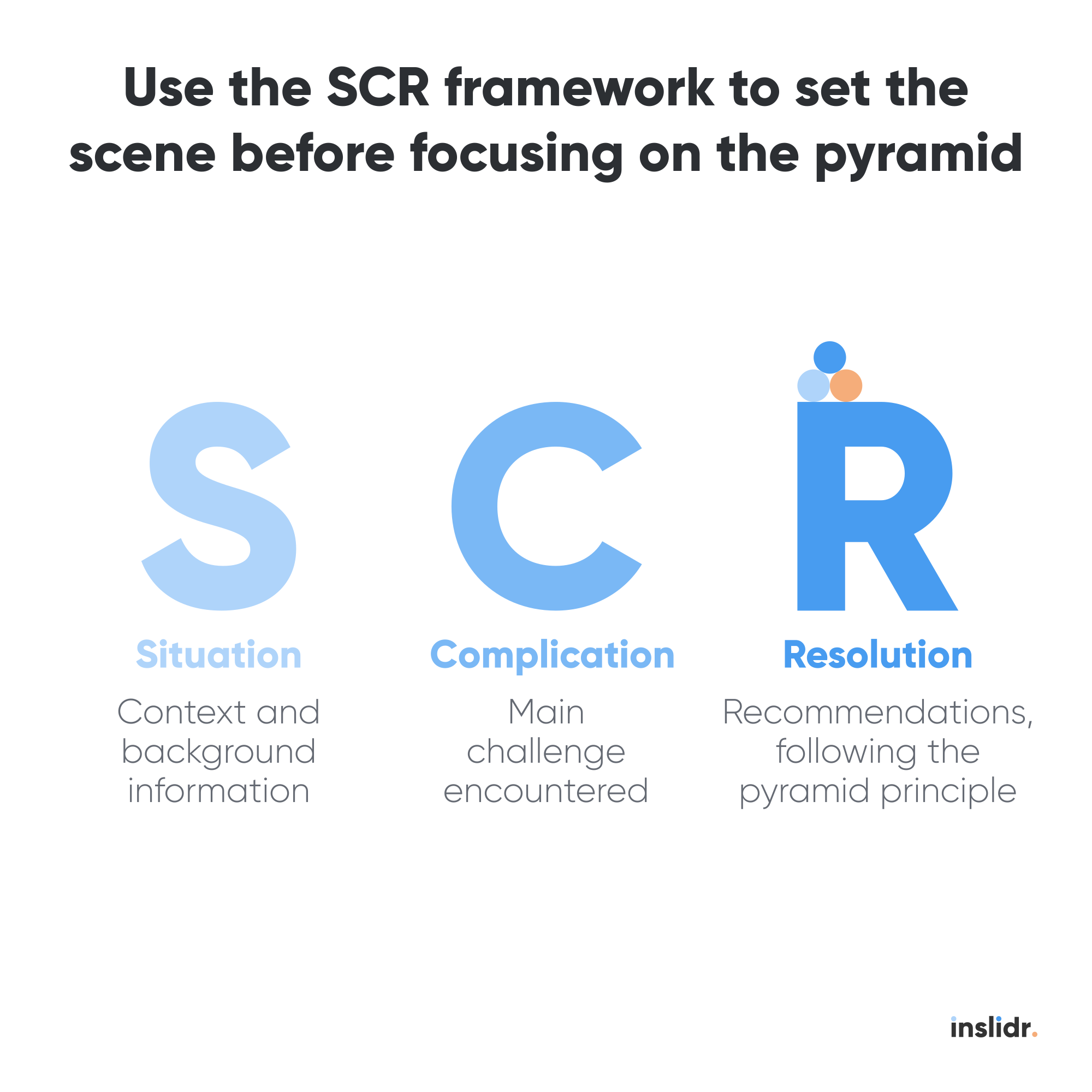
So you need a bit of context before the top-down answer, without falling back into a long, chronological build-up that keeps executives waiting for the point. That is precisely what the SCR framework (Situation, Complication, Resolution) does.
What is the SCR framework (Situation, Complication, Resolution)?
SCR is a storyline framework, used in many consulting executive summaries. It stands for Situation, Complication, Resolution. It’s a simplified, widely-used variant of Barbara Minto’s original SCQA framework (Situation, Complication, Question, Answer), the introductory structure she built into the Pyramid Principle.
Situation
A neutral description of the current state: market conditions, organisational circumstances, relevant history. The starting point everyone agrees on. In a story, it is where you get to know the hero.
Complication
The tension that disrupts the situation and makes a decision necessary. This is the turning point that creates interest.
Resolution
Your proposed response, delivered top-down. In most cases this is the most important part.
Left at a single sentence, the Resolution states what you recommend but not why. In practice, the Resolution is the core of your story: keep the Situation and Complication short, and spend most of your effort here. Because it carries the substance, it gets structured in more depth, not as a single line, but as a full pyramid: your main message on top, then the two to four supporting arguments that justify it, each backed by evidence.
This deployed Resolution is not improvised. It follows the Pyramid Principle, the reference top-down framework popularised by Barbara Minto at McKinsey. Those supporting arguments should be MECE: distinct enough that they don’t overlap, and complete enough that together they make the full case.
This is the heart of how SCR and the Pyramid Principle fit together: they are not competing frameworks. The SCR gives your story its overall frame and lets you add context; the pyramid structures the Resolution inside it. Situation and Complication set the scene bottom-up; the Resolution then flips to top-down and delivers the answer.
We cover how to build that pyramid (main message, supporting arguments, supporting evidence, the rule of three) in dedicated articles on the Pyramid Principle and the MECE principle.
inslidr tip – adjust the split based on your audience
The more senior the room, the shorter your Situation and Complication should be. With junior or middle-management audiences, who often want to understand your methodology and will give you more time, you can spend longer on context before reaching the recommendation.
Situation, Complication, Resolution: a concrete example
💡
SCR example (EcoHome)
Situation
EcoHome has experienced steady success in the market over the past 10 years.
Complication
Competition has intensified and profits began to decline since last year.
Resolution
EcoHome must innovate and shift to direct-to-consumer sales.
- Current products are outdated.
- Competitors offer cheaper alternatives.
- Solar panel sales have slowed.
- Consumers now prefer smart home technology.
- 60% of consumers prefer smart home products.
- Competitors saw a 15% increase in sales after launching smart home products.
- Direct-to-consumer sales increase profitability.
- Direct-to-consumer brands report higher profit margins.
- Competitors saw a 10% higher conversion rate with direct sales.
On an actual executive summary slide, you’d usually keep the top two levels and deploy the evidence across the deck.
Why add context at all, if top-down works?
If busy executives want the answer first, why not skip Situation and Complication entirely and open directly on the pyramid? A few reasons make the short build-up worth keeping:
A presentation that opens cold on a conclusion, with no shared context, can feel jarring, even to an audience that ultimately wants to move fast.
More importantly, context reduces the risk of misalignment: if your audience doesn’t share your reading of the situation, your recommendation has nothing to stand on, no matter how well the pyramid is built underneath it.
The Situation and Complication aren’t there to build suspense. They’re there to make sure everyone starts from the same page before you deliver the answer.
Where SCR comes from: the narrative arc
The SCR is, in essence, a business adaptation of the narrative arc. The narrative arc is the structure behind most stories we know, from exposition through rising action, climax and falling action to resolution. That structure is chronological and linear: it deliberately withholds the ending to build tension.
That is exactly why it does not work for a business presentation. Executives don’t want suspense; they want the conclusion. Consultants kept the idea of setting the scene before the payoff, but flipped the payoff itself to top-down. The result is SCR with a pyramid as the R. If you want to explore the narrative arc itself, Reedsy has a good overview.
A familiar example: The Lion King as an SCR
Let’s take the example of a story you already know: The Lion King.
💡
SCR The Lion King
Situation
The Pride Lands are a prosperous kingdom. Simba is the heir, learning from his father, Mufasa.
Complication
Scar, Simba’s jealous uncle, kills Mufasa, tricks Simba into fleeing, and seizes the throne, leaving the kingdom to fall into ruin.
Resolution
Simba must return, defeat Scar, and restore balance to the Pride Lands.
- The kingdom had fallen into ruin and needed a rightful leader.
- Scar ruled selfishly, ignoring the balance Mufasa had taught.
- Without a true king, the Pride Lands collapsed.
- Simba had to overcome his guilt and his past to step up.
- He had fled believing he caused Mufasa’s death.
- Nala and Rafiki convinced him to confront that past rather than hide from it.
- Restoring balance secured the kingdom’s future.
- Simba defeated Scar and reclaimed his role.
- He and Nala continued the circle of life.
Same story, told the way an executive would want to hear it: some quick context first, and then a focus on the solution and the reasons underneath.
Conclusion
The SCR framework is one of the most practical tools you can add to your presentation toolbox. Keep your Situation and Complication short to set the scene, then deliver your Resolution top-down as a pyramid. That combination is what makes SCR work in a business setting.
Keep in mind that SCR is built for presentations meant to convince a decision-maker. A purely informative presentation (a status update for example) often has no real Complication, and works better as several parallel key messages, one per category, each built with its small pyramid.
Stay flexible though and be mindful of your audience. No framework is perfect, you can even create your own.
To see how SCR and the pyramid come together in a full presentation, from executive summary to final slide, read our complete guide to building a consulting-style presentation.
If you liked the post, share it with your friends!

Leave a Reply