
Introduction
Think about the last time you sat through a presentation where you had to wait until slide 15 to understand what the speaker was actually recommending. Or a report where the conclusion only appeared after pages of methodology and data.
This is one of the most common mistakes in business communication. Audiences, especially senior ones, don’t want to follow your thinking process or the analysis for its own sake. They care about impact on the business and want to understand what decisions they need to take.
The Pyramid Principle is the framework that fixes this. It leads with the answer, then provides the reasoning. Developed by Barbara Minto during her time at McKinsey in the 1970s, it remains the reference method for structured communication in consulting and beyond. Once you understand it, you will see it everywhere, and probably never go back to how you used to build presentations.
What is the Pyramid Principle?
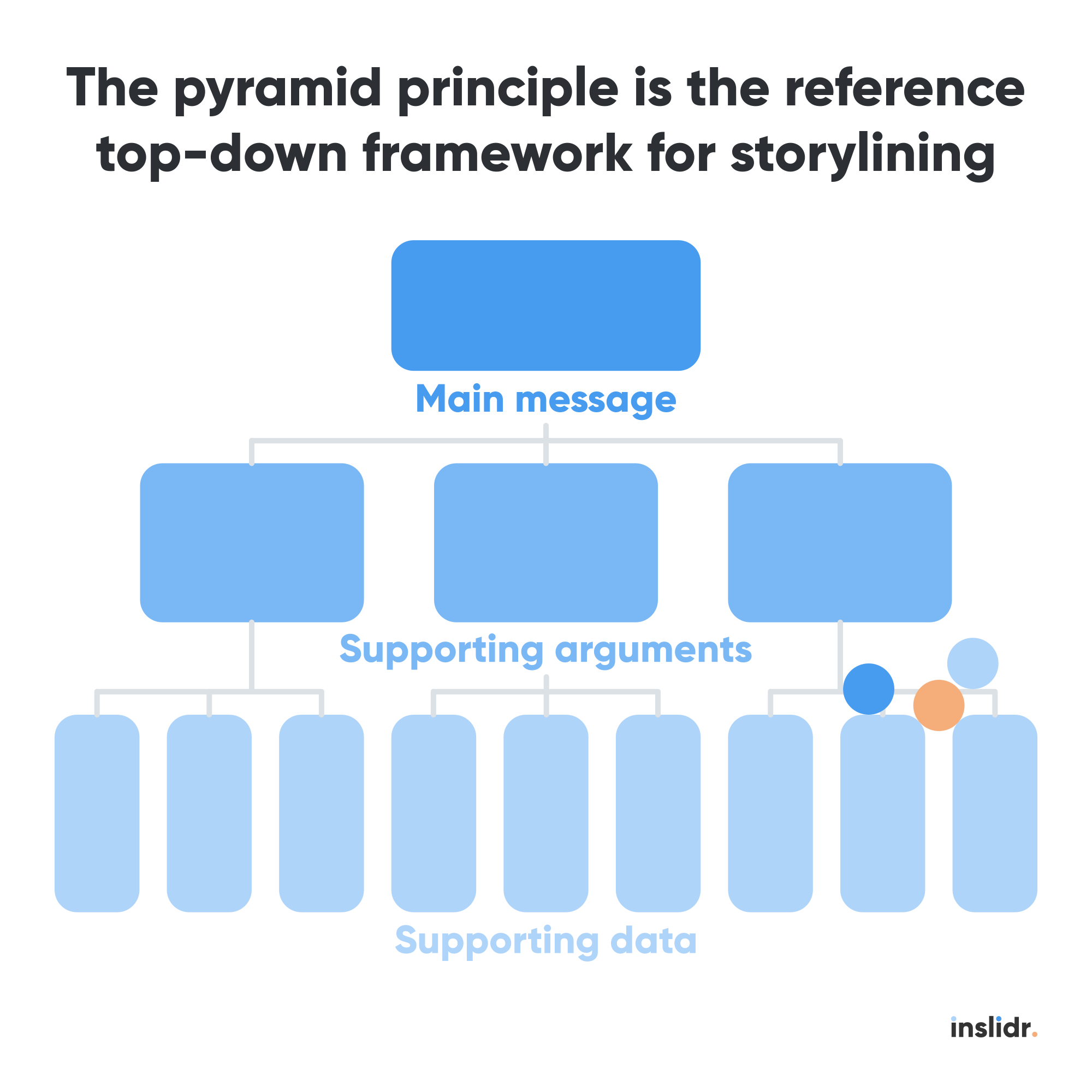
The pyramid principle is a very simple yet powerful tool. It was popularized by Barbara Minto at McKinsey and is now widely used, especially in consulting. It is a framework presenting information in a hierarchical top-down manner, in the form of a three-level pyramid. In this framework, the main message comes at the top, supported by supporting arguments, each backed by pieces of evidence.
Top level: main message.
This should be a clear, concise statement that summarizes the essence of your story. It should be your key message, the conclusion.
Middle level:supporting arguments.
This consists of the main arguments reinforcing your main message. Arguments are clustered logically in MECE (Mutually Exclusive, Collectively Exhaustive) themes. They are distinct enough that they don’t overlap, comprehensive enough that they fully justify your main message.
Read more: The MECE principle explained with examples
Base: supporting data.
The base of the pyramid contains the detailed information, data, and evidence which back your supporting arguments and form the clusters. This is where you provide the depth and richness that underpin your story.
A Pyramid Principle example
Say you are presenting to your leadership team on a struggling product line. A bottom-up structure would walk them through your market research, competitive analysis, and financial data, before eventually landing on a recommendation. Most business presentations work this way.
A pyramid-structured presentation looks different:
💡
Pyramid Principle example (EcoHome)
Top level: EcoHome must innovate and shift to direct-to-consumer sales to regain profitability.
- Current products are outdated.
- Competitors offer cheaper alternatives.
- Solar panel sales have slowed.
- Consumers now prefer smart home technology.
- 60% of consumers prefer smart home products.
- Competitors saw a 15% increase in sales after launching smart home products.
- Direct-to-consumer sales will increase profitability.
- Direct-to-consumer brands report higher profit margins.
- Competitors saw a 10% higher conversion rate with direct sales.
Your audience understands your recommendation in the first sixty seconds. Everything that follows is there to support it, not to build up to it.
Why top-down structures work
In a company, top-down structures generally work very well, especially with executives but not only. It can be counter intuitive as we are usually not used to starting with the answer, but it has different benefits.
Capture your audience’s attention early.
Top-down approaches are very direct, they start with the key messages or conclusions you want your audience to take away. If you quickly give your answers, your audience will be curious and start listening faster.
Give busy executives the answer they’re after.
Business leaders are more interested in your conclusions than in what led you to them. They will probably challenge you more on your recommendations than on your methodology. In a business presentation, you should not wait too long until you tackle your conclusions.
Make sure you deliver your main messages.
Giving your key points fast ensures that what’s most important is tackled, even if you don’t get to go into the level of details you wanted to. It is particularly important if your audience does not have time to go through your entire presentation, which can happen with senior audiences for example. When you present, you are the guide, people will react to what you present. You don’t want to spend your time discussing one third of your main messages.
Being able to do this can help you in other contexts as well. In an interview process for example, it can happen that the interviewer does not let you finish your answer before switching to another question. It happened to me once. In this case, I switched to top-down answers and it was super helpful. Even if I did not always get to tell all my points, I still managed to tackle the key messages in the limited time I had. And I could dive into the supporting details as needed if the interviewer gave me more time.
Improve clarity.
The structure of top-down stories make them clear, to the point, and easy to follow without losing focus. In an interview process, it also helps the interviewer see that you are a structured person. Similarly, adopting a top-down approach could also help you not to lose track of your thinking process and the big picture.
The rule of three
Within the pyramid, consultants typically aim for three supporting arguments, each backed by three pieces of evidence. The rule of three is not arbitrary: research on communication consistently shows that groups of three are easier to process and remember.
In practice, you will not always hit exactly three. Two strong arguments are better than three weak ones. But it is a useful target to aim for when structuring your story.
What makes a good main message?
The most common mistake when applying the Pyramid Principle is writing a weak main message, one that describes rather than asserts.
❌ Weak: “This presentation covers EcoHome’s market position and strategic options.”
✅ Strong: “EcoHome must innovate and shift to direct-to-consumer sales to regain profitability.”
A good main message is a statement, not a topic. It takes a position. It tells your audience what to think, not just what you will talk about. If your main message could apply to any presentation on any company, it is not specific enough.
How the Pyramid Principle connects to the rest of your presentation
The Pyramid Principle is not just a thinking tool, it is one piece of a larger communication framework.
In practice, the pyramid rarely stands alone. It often structures the Resolution part of a presentation, embedded within the SCR framework (Situation, Complication, Resolution). The SCR framework is a simplified, popularized variant of Minto’s own SCQA introduction (Situation, Complication, Question, Answer). It provides a short narrative opening before the top-down argument kicks in. The Situation establishes a quick shared context. The Complication creates the need for a response. The Resolution is where your pyramid takes over: main message first, supporting arguments below, then supporting evidence.
This SCR + Pyramid combination will form your deck storyline, used to produce the executive summary and the storyboard.
On the executive summary slide itself, you’ll usually show only the top two levels: the main message and the supporting arguments. The base of the pyramid, the evidence, is deployed across the deck, partly in the bodies of the argument slides, partly as deep-dive slides of their own, each titled with the evidence point it proves.
Conclusion
The Pyramid Principle is one of the most practical and transferable tools in business communication. Start with your main message. Ask yourself: if my audience only takes one thing away from this presentation, what should it be? Build your supporting arguments from there. Let the evidence follow.
It is not complicated, but applying it consistently requires deliberate effort, especially if you are used to building presentations bottom-up.
It is also not a complete solution on its own. The pyramid principle works best in combination with the SCR framework for a short narrative opening, and the MECE principle to keep your logic airtight. Together, these three form the core tools behind consulting communication.
To learn how to apply this in a full presentation, read our complete guide to building a consulting-style presentation.
Done well, this approach will make your presentations clearer, your meetings more productive, and your recommendations more persuasive, regardless of your industry or seniority level.
If you found this guide useful, share it with friends and colleagues who might benefit.

Leave a Reply